Mother Nature Strikes Again

Contributed by Teresa Douglass, Genealogy Specialist

Has the recent snow and cold weather kept you stuck in the house for a few days? Well, things could be worse – you could be stuck on a tugboat in a frozen river. For a month!

This week, we take a look back at the harsh winter of 1940 as seen through the eyes of a tugboat pilot. The following are entries from a pilot’s log of the M. S. King’s Landing, a tugboat of the Kosmos Towing Co. of Kosmosdale, Kentucky. The log covers the boat’s travels from 1938 to 1943. The examples shown here are from January 1 through February 20, 1940, when thick ice and frigid temperatures left the King’s Landing immobile for nearly a month. The crew increasingly deals with snow and ice in early January as winter weather worsens. By January 18th, they are forced to tie up in Spotsville, Kentucky, along the Green River, which becomes solidly frozen. The King’s Landing is stuck in this situation until February 16th, and resumes work and travel on the Ohio on the 17th.

Summaries of the entries accompany the following images. Full transcripts are available for these and the entire five-year journal in the Pilot’s Log – King’s Landing collection.

kingslanding 1


January 1st – 5th: snow and ice begin to mount

1st – Heavy snow storm

2nd – Ice in the river

3rd – Fog, river about full of ice

4th – Ice is fairly heavy

5th – Ice getting heavier, river frozen solid.

kingslanding 2


January 5th– 16th: ice increasingly makes river travel difficult

5th – stalled in heavy ice, broke through, then stuck again

6th – still cold, making ice all the time, 12 below zero

7th – not as cold

8th – broke ice up above the dam, tried to run through-not much success

9th – still cold as everything.

10th – warmer

11th – warmer, able to break through the ice

12th – warmer, but ice isn’t leaving very fast

13th – colder, layed up all day

14th – layed up at Owensboro

15th – at Stanley, KY, 6:30 pm, heavy ice storm from Yankeetown, IN to the Green River

16th – traveled back and forth between the mouth of the Green River and Evansville, IN

kingslanding 3


January 16th – 31st:  temperatures drop and ice builds making travel impossible

16th – Green River, ice is heavier. Froze about ½ inch previous night

17th – tied up, heavy ice in river and turning colder

18th – temperature is zero. Tied up at Spotsville, KY; turning colder

19th – continue to lay up at Spotsville; 10 below zero that morning

20th – 31st – Layed up at Spotsville

kingslanding 4


February 1st – 20th: remain stuck until mid-February

1st – Layed (sic) up at Spotsville; Green River has ice 8 inches thick. Frozen solid from bank to bank.

2nd – 6th – Continue to stay put at Spotsville

7th – ice in Green River is nearly gone. River raised 2 feet during the night.

8th – all ice gone in Green River

9th – 13th – continue to stay put at Spotsville, waiting for ice in Ohio River to thaw enough for travel

13th – ice breaking up in the Ohio River

14th -15th – stay put at Spotsville

16th – travel from Spotsville to the mouth of the Green River. Ohio River still about ½ full of heavy ice

17th –  ice nearly all gone by morning. Left mouth of Green River at 6:00 am and resumed travel and work on the Ohio.

18th – 20th – some ice and fog, but otherwise able to continue with normal workload

Mother Nature Strikes Again Read More »

Looking Back at the 1937 Flood

Contributed by Teresa Douglass, Genealogy Specialist

This year marks the 89th anniversary of the 1937 Ohio River flood, one of the most devastating natural disasters to occur in our region. Spreading from Pittsburgh, Pennsylvania, to Cairo, Illinois, the flood left thousands homeless and caused millions of dollars in damage.

The flood took place in late January and early February of 1937 and impacted a multitude of cities and communities along the Ohio River. Record-breaking rainfalls fell atop already swollen water levels from early through mid-January, causing the Ohio to overflow its banks by the 18th of that month. In the Louisville area, water levels reached a peak of 57 feet on January 27th. At this time, approximately 70% of the city was underwater. New Albany and Jeffersonville were likewise affected, as were numerous small riverside communities in the region. In Harrison County, Indiana, the towns of Mauckport and New Amsterdam were all but destroyed. Downtown Corydon was also affected as Indian Creek spilled deeply into local streets. It was not until February 5th that water levels finally fell below the flood stage.

The flood washed away or severely damaged numerous homes in surrounding urban areas, leaving many families stranded. Flood victims from the New Albany and Jeffersonville areas, as well as local communities such as Mauckport, found shelter and aid throughout Harrison County. They were quartered in lodge halls and private homes throughout the county, and at the Civilian Conservation Corps Camp at the State Forest. Corydon served as the relief headquarters where lodging was arranged, and food, cots, clothing, and other supplies were dispersed.

Here are a few images from our Fires & Floods collection that document the devastation in our area.

Additional photos of the 1937 flood, including images of areas in Corydon and New Albany, are available in the FPG Center Digital Archives’ Fires & Floods collection.

1937 flood 1Mauckport at the flood’s peak.

1937 flood 2New Amsterdam on February 2, 1937, as the river was receding after nearly 3 weeks of having left its banks.

1937 flood 3Rooftops and treetops are all that is visible of the Dam 43 area in Taylor Township.

1937 flood 4Victims of the flood stand on the steps of the Masonic Temple in Corydon as they wait to receive needed supplies.

1937 flood 5Donated goods are stacked along the sidewalk in front of the Masonic Temple.

Looking Back at the 1937 Flood Read More »

Historic marker at the Corydon branch of HCPL replaced

On Wednesday, January 7th, Steven Schifcar, head of grounds & maintenance, Trevor Smith, systems administrator, and Town of Corydon employees placed a new historic marker on the existing base in front of the Corydon branch.

The old marker had deteriorated.

former historic marker Old Capital Bank and Trust

The updated marker includes the building’s history on one side and the library’s history on the other.

new historic marker photo 1 new historic marker photo 2

Historic marker at the Corydon branch of HCPL replaced Read More »

Time for a check up!

Contributed by Teresa Douglass, Genealogy Specialist

In January, many of us focus on getting fit and healthy. To help inspire you in this pursuit, this week we highlight images from our Health Care in Harrison County digital collection. For more inspiration, visit the collection.

Here’s to your good health!

health1Dr. Fred R. Bierly examines his grandson in this ca. 1940 photograph. Dr. Bierly was a practicing physician at Elizabeth for 43 years.

health2Dentist Dr. Howard K. Binkley examines Robert Bosler Jr., a school student at Depauw. Dr. Binkley had a dental practice in Corydon from 1939 to 1975.

health3Dr. Carl E. Dillman and county nurse Lillian Johnson (far right) provide immunizations to students at New Amsterdam in March 1940. Dr. Dillman was a general practitioner in Harrison County for 46 years, from 1935 to 1981. Dillman was known as a tireless worker who delivered hundreds of babies and continued to conduct house calls up until his retirement.

Time for a check up! Read More »

The “Little Brown Church in the Vale”

Contributed by Teresa Douglass, Genealogy Specialist

A wide variety of churches have existed and thrived in Harrison County throughout its history.

In this week’s Flashback, we’ll look back at a few churches that are no longer standing but were once important centers of their surrounding rural communities.

churches1Old Goshen Baptist

Old Goshen Baptist Church is credited with being the first church built in Harrison County and the second-oldest Baptist church in Indiana. Moses Boone, son of Squire Boone, and George Bartley built the log church on Boone’s farm about two and a half miles north of Laconia in 1813. The men used poplar and oak logs to construct the 20 x 30 ft. building, a simple structure. Baptists used the structure for over sixty years, followed by congregations of Dunkards and United Brethren.

Around 1900, the building was largely abandoned. The local community, however, continued to use it occasionally as a school, meeting hall, and reunion site. Despite repairs and alterations over the decades, the building’s condition has deteriorated. Concern for the historic structure prompted local citizens to urge the State of Indiana to preserve the site, and in 1943, the Indiana General Assembly approved an act making Old Goshen Church and Cemetery an official Indiana Memorial. The Department of Conservation was authorized to maintain and preserve the building and grounds. Unfortunately, no funding was appropriated to fulfill this promise, and the property continued to decline. After several years of the state’s inaction and neglect, local citizens formed the Old Goshen Church and Cemetery Foundation in 1955. The state deeded the property to the Foundation, but by the early 1960,s the old log structure was in an advanced stage of decay. It was torn down in August 1961. In 1991, the Foundation constructed a reproduction of the original log church on the site.

churches2Luther’s Chapel

Luther’s Chapel was constructed in 1844 along what is now Old Forest Road. Its Lutheran congregation formed under the leadership of Reverend Peter Glenn as a splinter group from Mt. Solomon Evangelical Lutheran Church. During the Civil War, Glenn, a staunch abolitionist, was shot and killed during an encounter with the Confederates as they came through Harrison County in July 1863. The Luther’s Chapel congregation continued for a number of years, but it eventually dissolved and sold the building to a Methodist group in 1897. Services were discontinued in the church, and it was razed in 1914.

churches3Shiloh United Brethren

This frame, gable-front church was constructed south of Corydon ca. 1854. The congregation formed around 1837 in the vicinity of Jordan Cemetery along the Corydon-Mauckport Road (now Old 135). In the late 1840s, members decided to build a church but were divided on where to site it. Those who lived closer to Corydon wanted it on a road near town. Others found the Jordan Cemetery area more convenient. The “town” group eventually split from the congregation to construct a church in their preferred location. The Jordan group stayed in their area and built the Shiloh church. Shiloh United Brethren closed in 1926, and the church was torn down in 1950.

churches4Wood’s Chapel

The Wood’s Chapel congregation was organized in 1836 in the Hurstown area. The building pictured here was the third church built by the congregation. The first was a basic structure built in 1841, and the second was completed in 1881. The congregation constructed its third church building, seen above, in the early 1950s. Services were first held in the building on January 13, 1953. In 1970, the Wood’s Chapel congregation merged with four other Methodist congregations (Depauw, Louden’s Chapel, Pennington Chapel, and Ramsey) to form Unity Chapel. This new organization constructed a large, modern church building in the Ramsey area in 1972. After this, the Wood’s Chapel Church was razed.

To see and learn about additional churches, visit the Harrison County Churches collection. Images of several Harrison County churches are also available in the Walter and Mina Fried Slide Collection.


The “Little Brown Church in the Vale” Read More »

Who's Awesome December 2025

Who’s Awesome! Lisa Griffith – December 2025

Lisa Griffith, Corydon circulation clerk, was HCPL’s Who’s Awesome! winner for December. Lisa was one of 11 nominations for the honor this month.

Tiffany Thieneman, HCPL’s public service manager, nominated Lisa writing, “Lisa always thinks of me when she comes across an idea or picture of a craft that I could possibly use for Clever Crafts. I appreciate that she sends me a picture so I can add it to my collection of ideas. Lisa is awesome!”

In her July 2024 nomination of Lisa, Ellie Tucker-Brown who works in the reference department at Main, wrote, “Lisa has always been extremely helpful assisting patrons when I work with her on Thursday evenings. She extends this helpfulness to me as well. I appreciate her cheerful attitude and willingness to pitch in.”

Lisa joined the HCPL circulation staff in July of 2021.

Each month a winner is selected by random drawing. Other staff members nominated in December were Bethany Banet, Teresa Douglass, Amanda Embrey, Nikki Esarey, Jaymee Jansa, Shawnda Mosson, Jon Schraffenberger, Leo Stiner, and Ellie Tucker-Brown.


Article by Alisa Burch, Director

Who’s Awesome! Lisa Griffith – December 2025 Read More »

Season’s Greetings from HCPL!

Contributed by Teresa Douglass, Genealogy Specialist

Sending Christmas cards has been a long-standing tradition in our community. Here are a few personalized examples from the Griffin Center’s collections:

A 1906 Christmas postcard from Sallie Kintner Jones. The Kintner family operated a prominent inn in downtown Corydon. Sallie inherited the inn following her father’s death in 1880. In 1881, she married prominent local attorney Major William T. Jones. Within a year, William died unexpectedly. Sallie never remarried, but continued to live in and manage the Kintner Inn. She shared management of the hotel with her brother William W. Kintner until his death in 1896, after which, Miss Sallie, as she was known, became the sole innkeeper. She continued to live at the inn, but contracted individuals to manage the business. She closed the hotel in 1920 and died two years later. In the 1980s, the Kintner hotel building was restored to its original appearance and use. In December 1986, the Kintner House reopened as a bed and breakfast and continues as such today.

This image is part of our “People We Know” collection, which has more than 400 images of individuals from Harrison County’s past.

This image of the Sprauge steamboat served as the 1947 Christmas card of Mr. and Mrs. Jesse P. Hughes. Captain Jesse Paul Hughes (ca. 1877-1973) was a pilot on the Ohio River for nearly 70 years and worked primarily for the Greene Line of Cincinnati, Ohio at the helm of the Delta Queen. Hughes was also an accomplished artist and painted numerous images of early steamboats.

The Sprauge was built in Dubuque, Iowa in 1901 by Peter Sprauge for the Monongahela River Consolidated Coal and Coke Company and was the world’s largest steam powered sternwheeler towboat. Nicknamed “Big Mama,” the Sprauge had the capability to push 56 barges at once, and in 1907, the ship set a world’s all time record for towing 60 barges of coal weighing over 67,300 tons. The Sprague was decommissioned for towing in 1948, became a museum in Vicksburg, Mississippi, and burned in 1974.

This image is part of our “Transportation” collection, which features a wide variety of steamboats, locomotives, and automobiles as well as early roads and bridges.

A 1951 Christmas card from the Griffin family. Frederick Porter Griffin (1915-2008).

This image is part of the “Griffin Family Photos” collection on our digital archives.

 Happy Holidays to all from the Harrison County Public Library and Frederick Porter Griffin Center staff!

Visit HCPL’s digital archives for these and more wintery scenes.

Season’s Greetings from HCPL! Read More »

Read to Feed Harrison County 2026

Get cozy this January while you Read to Feed Harrison County!  The winter reading challenge is open to all ages, January 1 – 31.  The goal is to read 10,000 books as a community. If the goal is reached, Harrison County Community Services will receive $1,000 from Duke Energy, $1,000 from Lucas Oil, $500 from Caesars Southern Indiana, $250 from Eckart Supply, and $200 from REMC. Canned food will be collected at all library branches.

During the Winter Reading Challenge, everything counts! Books, eBooks, audiobooks, and magazines can be used from any source, both library and personal. Check out free books and audiobooks from Overdrive or the Libby app, and enjoy digital materials without wait times on Hoopla. Track your reading with Beanstack to earn badges and explore activities inspired by this year’s theme, Read with Benny! You are challenged to read at least 10 books in the month of January to unlock the badges.

If you have participated in a reading challenge with us before, you already have a Beanstack account. The library will assist you if you have any difficulties logging on. If you do not want a Beanstack account, the library will be happy to log your reading for you. Just stop in at any library branch to pick up a Winter Read bookmark. HELP READ TO FEED HARRISON COUNTY!

Read to Feed Harrison County 2026 Read More »

Let it Snow

Contributed by Teresa Douglass, Genealogy Specialist

Let it snow, let it snow, let it snow . . .

Whether you love the white stuff or can’t wait to see it go, one thing’s for sure, it’s been a regular winter visitor in Harrison County over the years. Plus, it makes for a great picture!

Here are some past snow days for you to enjoy. Pass the hot chocolate!

Harrison County Fairgrounds, 1909. This winter scene features the Little Ring area in the southwestern portion of the property. The bare trees and fresh snow provide a clear view of the seats built into the hillside. The judge’s stand and amphitheater are also in view, and the trail of the spring branch can be seen in the foreground.

The old north bridge over Indian Creek near Cedar Glade looks a bit more treacherous ca. 1925 than today’s version.
A boy shovels snow from the sidewalk in front of the post office on Chestnut Street in Corydon ca. 1958.
The Corydon Country Club hill was a favorite sledding spot for many when covered with a blanket of snow as seen in this 1968 image.
Snow piles up on Beaver Street in 1966. Yep, those are gas pumps at right in front of a Marathon station.
Hauling it away in January 1964!


Visit HCPL’s digital archives for these and more wintery scenes.

Let it Snow Read More »

Here Comes Santa Claus

Contributed by Teresa Douglass, Genealogy Specialist

The big man in red will be arriving soon, so I hope you are on his “good” list!

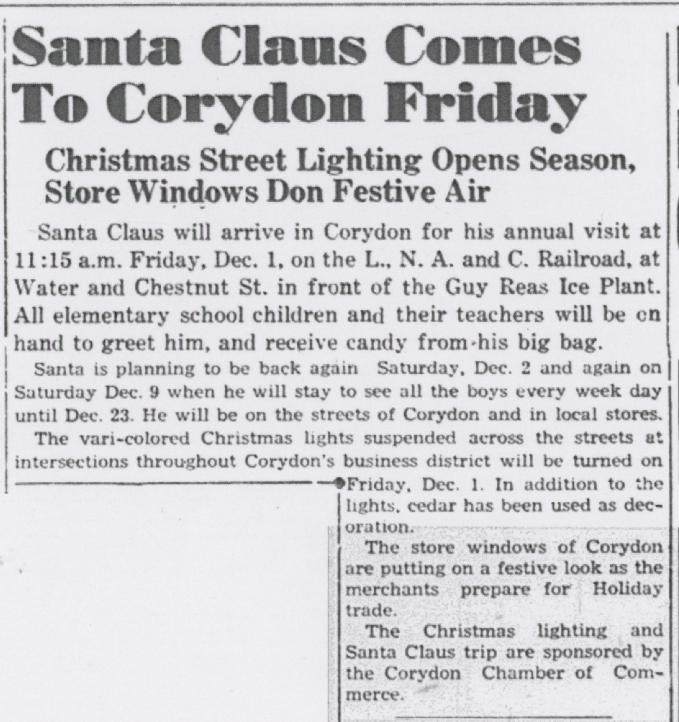
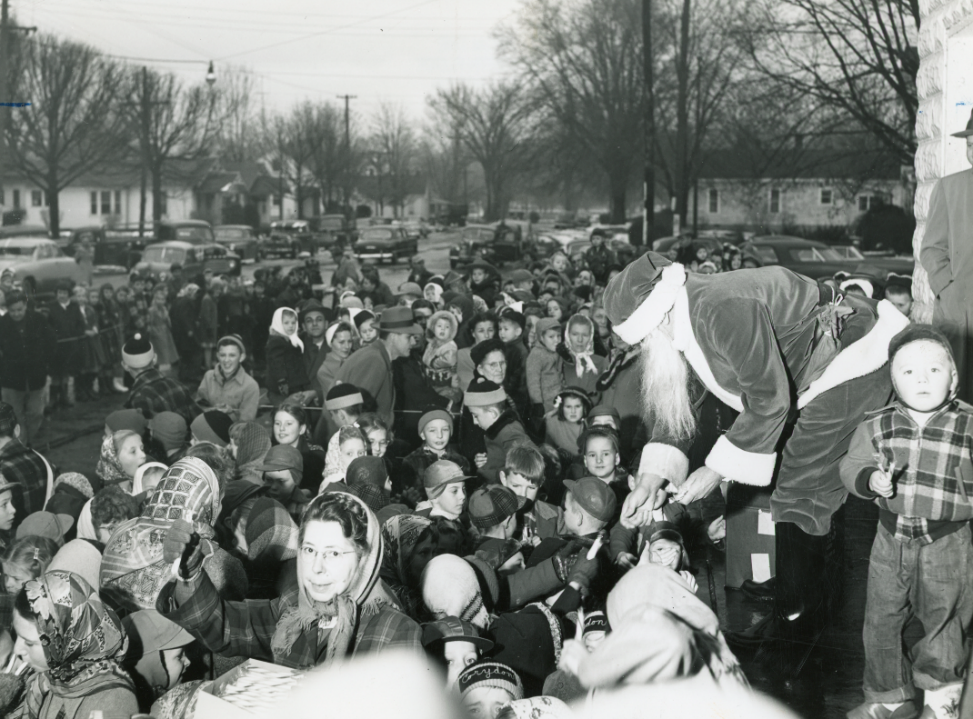
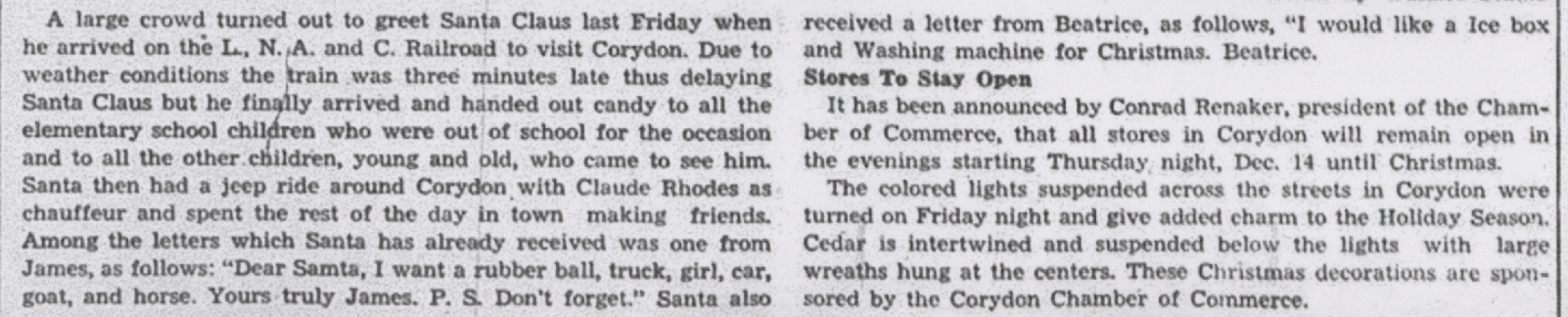
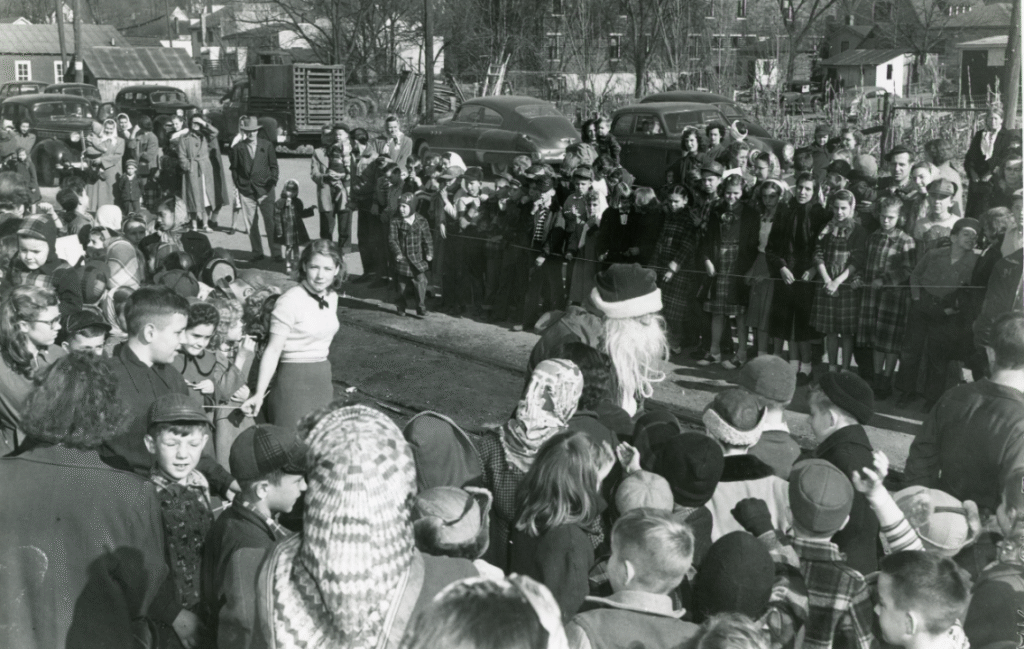
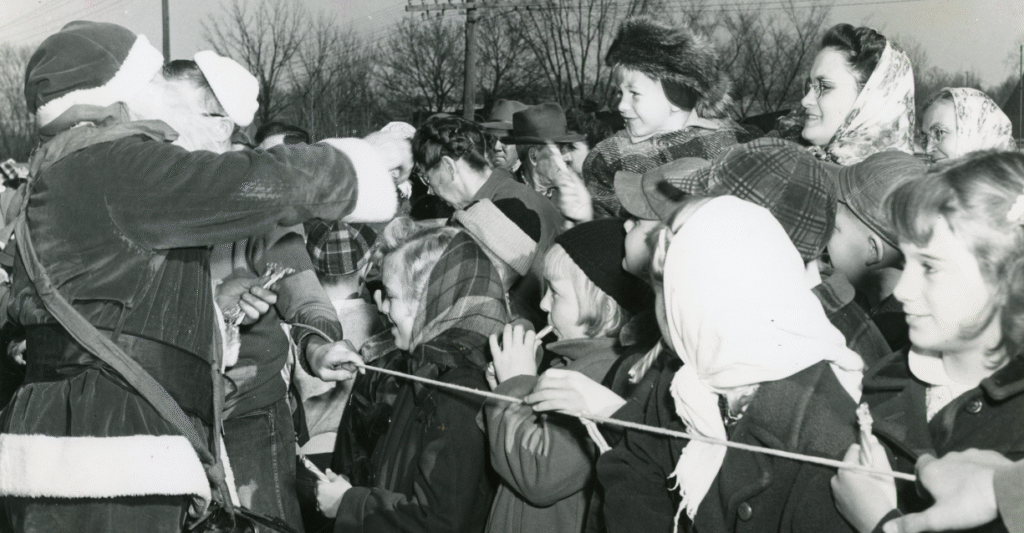
This week’s Flashback takes a look at Santa’s arrival in Corydon in 1950. Santa traveled via the LNAC (Louisville, New Albany, and Corydon) Railroad and greeted a large crowd on Water Street. Children were excused from school for the occasion.

Santa’s approaching arrival was announced in The Corydon Democrat, November 29, 1950 :


Another article, accompanied by the following photo, appeared in the paper December 6, 1950:

Additional photos of the day:

Happy Holidays!

For these and many more images, visit the Harrison County Public Library Digital Archives.


Here Comes Santa Claus Read More »

Scroll to Top