Protected: Are you ready for spring cleaning?
Protected: Are you ready for spring cleaning? Read More »
Contributed by Teresa Douglass, Genealogy Specialist
For many years, springtime in Harrison County meant attending the annual Pancake Festival on the square in downtown Corydon. The local Jaycees sponsored the event, which featured rides, cakewalks, and, of course, pancakes! Here are some images to help you remember the fun, or if you missed it, make you wish you could have gone!
One of the most popular events at the festival was a large pancake breakfast, which was always well-attended despite its early start. Above, Marvin Alstott (left) and Charles Miller (right) prepare cakes for the crowd in 1959. See the Corydon Photograph Collection.
A large Ferris wheel operated on Elm Street near the Masonic Lodge and Corydon Post Office in 1962.
Festival goers and rides on West Beaver and Elm Streets, 1968.
See more Pancake Festival images in the J. D. & Elizabeth Williams Slide Collection.
Pass the syrup! (and no riding the Octopus for at least an hour) Read More »
Contributed by Teresa Douglass, Genealogy Specialist

Seventeen-month-old Dickie Allen Mathews (1939-2009) holds a stuffed bunny and smiles tentatively for the camera. Dickie was the son of Everett and Margaret Timberlake Mathews of Corydon. He grew up and became a U. S. Marine. Dick eventually settled in Indianapolis, where he and his wife raised a large family and he worked for the railroad for more than thirty years.
Dickie’s photo is part of the archives’ People We Know collection.
Contributed by Teresa Douglass, Genealogy Specialist
On May 18, 1921, these six “ordinary” women took part in a historic event as members of the first “all-woman” jury in the Harrison County Circuit Court. Their photograph, along with an accompanying article, appeared in the May 25, 1921, edition of The Corydon Democrat.
Women in the United States gained the right to vote through the 19th Amendment, which was ratified in August of 1920. With this right also came the ability to serve on juries. In May 1921, Harrison County Circuit Court Judge William Ridley decided it was a “good time to give the women a chance to try their hand as jurors,” and these six women were summoned. They did their civic duty and simultaneously made a momentous step for women. They appear in the photo, left to right:
Laura Rowe Miller (1875-1963), sales clerk in department store
Bertha Mary Wright McFall (1885-1954), wife and mother
Zeola Kirkham Price (1888-1974), sales clerk in department store
Flora Alice Steepleton Dannenfelser (1873-1960), wife and mother
Bertha McCutcheon Duley (1882-1948), teacher at Corydon High School
Anna Elizabeth Krausgrill Gailey (1869-1935), mother of seven
The case these women oversaw was an appeal on a suit over ownership of a turkey, as the following article explains. (Suits over ownership of animals were fairly common at the time.) The article also points out that because it was a civil action, the case could be tried by a jury of fewer than 12 if both parties agreed, so only 6 jurors were necessary.
Women are well represented in many of the collections featured in the Griffin Center’s digital archives.
First Female Jury in Harrison County Read More »
Contributed by Teresa Douglass, Genealogy Specialist
This week, we feature some little-known Harrison County women who, although their names are not commonly acknowledged in the history books, made their mark in their fields and advanced women in their time.
Julia Fried
Julia Fried taught at various schools throughout Harrison County before moving to Indianapolis to teach. A staunch supporter of education and women’s suffrage, Fried went on to become a well-known and effective public speaker, lecturer, and writer throughout the state and beyond. She held prestigious positions in the Franchise League of Indiana, the Legislative Council of Indiana Women, Purdue University, and the Indiana State Teachers’ Association. In 1906, she married John W. Walker, editor of the Educator Journal. Following her husband’s death, Julia Fried Walker succeeded him as editor and publisher and was the only female to hold this position for some time. She also served as the national president of the organization of educational publications. Julia Fried Walker died in 1917 at the age of forty-one.

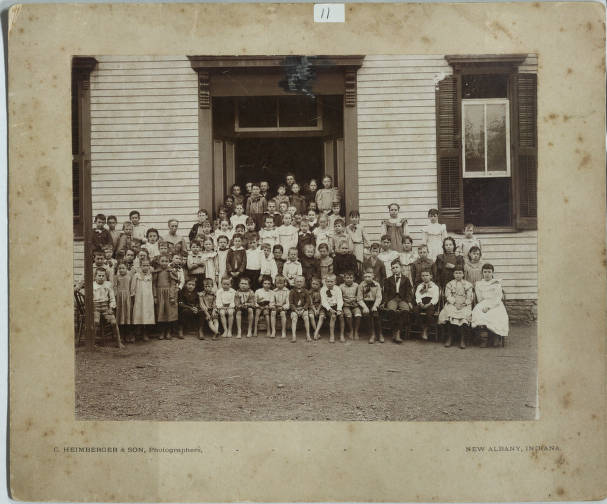
Julia Fried, ca. 1905, and with her students at Harrison Township School No. 9, Pitmans-Bickels School, ca. 1896. (The school was located southwest of Corydon near Indian Creek and Heidelburg Road.)
Visit HCPL’s Harrison County Schools collection.
Elva Cunningham
Elva Cunningham was a jeweler and is seen here repairing watches in the shop she and her brother operated in Corydon in 1936. At the time, Elva was reportedly the only female jeweler in Indiana. She went on to become an optometrist and opened a practice in Corydon after graduating from college in 1939. Unfortunately, Elva died in 1942 at the age of twenty-seven due to complications of diabetes.
Visit HCPL’s People at Work collection.


Eleanor and Grace Martin
Eleanor Jane (left) and Grace Neely Martin (right), daughters of Dr. George F. and Anna Neely Martin of Corydon, both pursued advanced degrees and had successful careers in their chosen fields.
Eleanor Martin (1896-1966) earned undergraduate and master’s degrees in art from Indiana University. She became a professional artist and studied in Germany for over two years at the State Academy of Fine Arts and the University of Munich. Eleanor became known for her portrait paintings and depictions of historical events. She and her husband, Dr. Preston A. Barba, a professor of German, lived in Pennsylvania, traveled extensively, and collaborated on many projects and publications. During World War II, Eleanor took courses in mathematics and drafting and, for two years, worked as a draftsman at the Consolidated Vultee Airplane Factory. Her work there included drawings for a pilot’s handbook.
Grace Martin (1896-1982) also attended Indiana University in Bloomington, where she studied German and earned bachelor’s and master’s degrees in 1918 and 1923. She joined the faculty of IU in 1923 and held a scholarship and a fellowship at Bryn Mawr College in 1927-1928 and 1928-1929. Professor Martin continued her career at Indiana University until her retirement in 1961.
Rev. Emma F. Hussung
Reverend Emma F. Seng Hussung (1883-1954) was a leading religious figure in Harrison County during the late 1930s through the mid-1950s. She was born in Louisville, Kentucky, and was inspired by the Salem Reformed Church, where she was raised. Emma quickly assumed a leadership position in the church, established Sunday schools, and eventually developed the Sunnydale Reformed Church. Emma pursued professional training at the Moody Bible Institute, the Presbyterian Seminary in Louisville, and Winona Summer Schools. She was ordained an interdenominational minister in 1932. She married George H. E. Hussung in 1907, and in the late 1930s, they moved their family to Harrison County, where Emma served the Christian churches at Central and Hill Grove. In 1942, she joined the United Brethren Conference and served as pastor at the Ramsey, Crandall, Byrnville, and Potato Run churches. During this period, she was the only ordained female minister holding a pastorate in Harrison County.
Images of Rev. Hussung and the Martin sisters are part of our “People We Know” collection: https://cdm17251.contentdm.oclc.org/digital/collection/p17251coll51
May these women inspire you to pursue your goals and discover what you can achieve.
Contributed by Teresa Douglass, Genealogy Specialist
As we celebrate African American History Month, we leave you with a few additional images of past Harrison County citizens and highlight some of the many African American history resources available at the Frederick Porter Griffin Center. These include individual family files and several history files that contain a variety of articles, research, and writing on African American history. Obituaries, cemetery records, and school resources can provide helpful information, as can maps and newspaper articles. Our collection also includes several sources on the Underground Railroad in Indiana, as well as various works on significant periods of African American history.
Resources that focus specifically on Harrison County include:
The Griffin Center also has a collection of newspaper clippings on local African American individuals and communities from 1870-2004, as well as an early register of African Americans dating to the 1850s.
Annie Belle Lewis (ca. 1873-1941).
Annie was the daughter of Philip and Malinda Wordling Lewis of Corydon. She worked many years as a servant and nanny for the Griffin family.

Anna Mitchem White (ca. 1850-1928).
Anna was the daughter of Andrew Mitchem. She married William White with whom she had several children. Anna was no stranger to hard work and loss. By 1900, Anna was a widow and had also lost five children. She had three children left at home, ages 11 to 16, and worked as a servant. Her eldest son, William, also lived with her, along with his wife and two children. In 1905, William also died. Anna continued to work as a laundress and housekeeper until her death in 1928.

William Brown Jr. (1889-1929).
“Willie” Brown was the son of William and Margaret Ann Brown of Corydon. Willie served overseas in World War I, then returned to Corydon where he worked as a laborer.
Historic African American resources at HCPL’s Griffin Center Read More »
Contributed by Teresa Douglass, Genealogy Specialist
Many African Americans from Harrison County have served in the military over the years.
The following images and newspaper articles provide a few examples of their contributions.

These four young men from Harrison County entered the service during WWI. They left Corydon for Camp Dodge, Iowa, on August 23, 1918. Standing left to right are: William Brown, Carlton Parker, and Percy Garner. Jesse R. Perry is seated in front.
Military Photograph collection

The Corydon Democrat
June 9, 1943


The Corydon Democrat
January 17, 1945
The Corydon Democrat
January 31, 1945

The Corydon Democrat
March 5, 1952

The Corydon Democrat
November 19, 1952
Honoring Harrison County African American Veterans Read More »
Contributed by Teresa Douglass, Genealogy Specialist
The Leora Brown School in Corydon is one of the most significant historic resources of Harrison County’s African American history. Built on Summit Street in 1891, the one-story, frame school building served the town’s African American students and remains the oldest standing African American schoolhouse in Indiana.
Originally known as the Corydon Colored School, the building served as both a grade and a high school with students from grades one through twelve. The school produced its first graduates in 1897. The high school was discontinued in 1925 due to low enrollment, and African American students then attended Corydon High School. Grade school for African American children continued in the Summit Street school until 1950, after which all students were integrated into the town school. The Corydon school system continued to own the school building on Summit Street and, in 1953, began using it for overflow kindergarten and first-grade students. In 1973, the building was renamed the Grade School Annex and served students with special education needs. In 1986, the school corporation declared the building as surplus and sold the property.

Leora Brown School in Corydon, ca. 1967.

Professor William H. Fouse

Professor William H. Fouse was the first African American teacher to teach at Corydon’s school for African American children. The school was built in 1891, and Professor Fouse taught there from 1893 to 1904.
Leora Brown had the longest tenure as teacher of Corydon’s African American school. A graduate of the school herself, Brown started teaching in 1924 and continued until 1950 when the school was closed and all its students were integrated into the larger Corydon schools. The school system, however, did not renew Brown’s teaching contract. In the early 1990s, the schoolhouse on Summit Street was restored and renamed the Leora Brown School in honor of its beloved long-time teacher.
Leora Brown School Read More »
Contributed by Teresa Douglass, Genealogy Specialist
In celebration of African American History Month, we take a look back at the lives and contributions of African American citizens throughout Harrison County’s history.
African Americans have been part of Harrison County’s history from its beginning, and as Black communities developed, residents soon organized church congregations. One of the first to be established was St. Paul’s African Methodist Episcopal (A.M.E.) Church in Corydon. Free African Americans and former enslaved persons organized the St. Paul congregation around 1843. In April 1851, church trustees acquired a lot in Corydon for the purpose of erecting a house of worship and a school. In the late 1870s, the congregation erected a frame, gable-front church at the corner of Maple and High Streets. The building, pictured below, served the St. Paul A.M.E. congregation until 1975, at which time a new brick church was built on an adjacent lot. This brick building continues to serve the congregation today.
Other early African American churches in Harrison County include Collins ’ Chapel in northern Boone Township and Zion Church in southern Harrison Township.
St. Paul’s African Methodist Episcopal (A.M.E.) Church in Corydon, ca. 1958.
The above image is part of the Walter and Mina Fried Slide Collection, available in HCPL’s digital archives.
This March 15, 1939, article from The Corydon Democrat announces a program sponsored by St. Paul’s in order to raise funds for needed repairs to the church.
St. Paul’s A.M.E. Church Read More »
Contributed by Teresa Douglass, Genealogy Specialist
Has the recent snow and cold weather kept you stuck in the house for a few days? Well, things could be worse – you could be stuck on a tugboat in a frozen river. For a month!
This week, we take a look back at the harsh winter of 1940 as seen through the eyes of a tugboat pilot. The following are entries from a pilot’s log of the M. S. King’s Landing, a tugboat of the Kosmos Towing Co. of Kosmosdale, Kentucky. The log covers the boat’s travels from 1938 to 1943. The examples shown here are from January 1 through February 20, 1940, when thick ice and frigid temperatures left the King’s Landing immobile for nearly a month. The crew increasingly deals with snow and ice in early January as winter weather worsens. By January 18th, they are forced to tie up in Spotsville, Kentucky, along the Green River, which becomes solidly frozen. The King’s Landing is stuck in this situation until February 16th, and resumes work and travel on the Ohio on the 17th.
Summaries of the entries accompany the following images. Full transcripts are available for these and the entire five-year journal in the Pilot’s Log – King’s Landing collection.

January 1st – 5th: snow and ice begin to mount
1st – Heavy snow storm
2nd – Ice in the river
3rd – Fog, river about full of ice
4th – Ice is fairly heavy
5th – Ice getting heavier, river frozen solid.

January 5th– 16th: ice increasingly makes river travel difficult
5th – stalled in heavy ice, broke through, then stuck again
6th – still cold, making ice all the time, 12 below zero
7th – not as cold
8th – broke ice up above the dam, tried to run through-not much success
9th – still cold as everything.
10th – warmer
11th – warmer, able to break through the ice
12th – warmer, but ice isn’t leaving very fast
13th – colder, layed up all day
14th – layed up at Owensboro
15th – at Stanley, KY, 6:30 pm, heavy ice storm from Yankeetown, IN to the Green River
16th – traveled back and forth between the mouth of the Green River and Evansville, IN

January 16th – 31st: temperatures drop and ice builds making travel impossible
16th – Green River, ice is heavier. Froze about ½ inch previous night
17th – tied up, heavy ice in river and turning colder
18th – temperature is zero. Tied up at Spotsville, KY; turning colder
19th – continue to lay up at Spotsville; 10 below zero that morning
20th – 31st – Layed up at Spotsville

February 1st – 20th: remain stuck until mid-February
1st – Layed (sic) up at Spotsville; Green River has ice 8 inches thick. Frozen solid from bank to bank.
2nd – 6th – Continue to stay put at Spotsville
7th – ice in Green River is nearly gone. River raised 2 feet during the night.
8th – all ice gone in Green River
9th – 13th – continue to stay put at Spotsville, waiting for ice in Ohio River to thaw enough for travel
13th – ice breaking up in the Ohio River
14th -15th – stay put at Spotsville
16th – travel from Spotsville to the mouth of the Green River. Ohio River still about ½ full of heavy ice
17th – ice nearly all gone by morning. Left mouth of Green River at 6:00 am and resumed travel and work on the Ohio.
18th – 20th – some ice and fog, but otherwise able to continue with normal workload
Mother Nature Strikes Again Read More »